
Discover the story behind 20 years of impact
A personal reflection by Marc Dullaert, Founder and Chairman of KidsRights, on how a simple question in 2004 led to the creation of the International Children's Peace Prize and a global movement that continues to amplify the voices of young changemakers today.
Autumn 2004
It was the autumn of 2004 in Schiermonnikoog, The Netherlands.
One evening, the announcement of the new Nobel Peace Prize winner was on the news. That same evening, there was also a television report about Iqbal Masih, a brave Pakistani boy who had stood up against child labour and paid for it with his life at the age of twelve.
My wife and I asked ourselves: why is there no Nobel Peace Prize for children?
After many journeys across continents, I came to realise that children are not only vulnerable, as they are often perceived, but that they also possess tremendous power and can bring about real change. There was a need for a platform where they could share their message and be heard. That night, the idea for the International Children’s Peace Prize was born.
I began seeking support for the idea among the Nobel Peace Laureates united in the World Summit of Nobel Peace Laureates, led by Mikhail Gorbachev. He was deeply moved when I asked him what he could learn from his grandchildren. As a result, he immediately understood the purpose of the International Children’s Peace Prize.
In November 2005, during the Summit of Nobel Peace Laureates at the Capitol in Rome, the first International Children’s Peace Prize was welcomed and posthumously awarded to Nkosi Johnson, who stood up for the rights of children living with HIV and AIDS.
Since then, year after year, more and more people around the world have been inspired by the courageous stories of winners such as Om Prakash, who stood up against child slavery, Thandiwe, who fought for the right to education in her country, and Chaeli, who championed the rights of children with disabilities.
Not only did the number of nominees grow every year, but the impact increased as well. Government leaders welcomed the International Children’s Peace Prize winners from their countries and laws were changed for the betterment of children’s rights. The International Children’s Peace Prize reached and touched hundreds of millions of people.
The now world-famous prize also had its darker side. The nomination of Malala from Pakistan proved to be one of the reasons she became a target. Her school headmaster nominated her, then an unknown girl, with a simple letter. We ultimately did not dare award her the Children’s Peace Prize because of concerns for her safety. Who could have imagined what would happen later? The nomination, which brought her into the spotlight, partly contributed to the attempt on her life.
"HEY YOU OLDIES, LISTEN TO THE CHILDREN AND ACT"
- DESMOND TUTU, PATRON KIDSRIGHTS
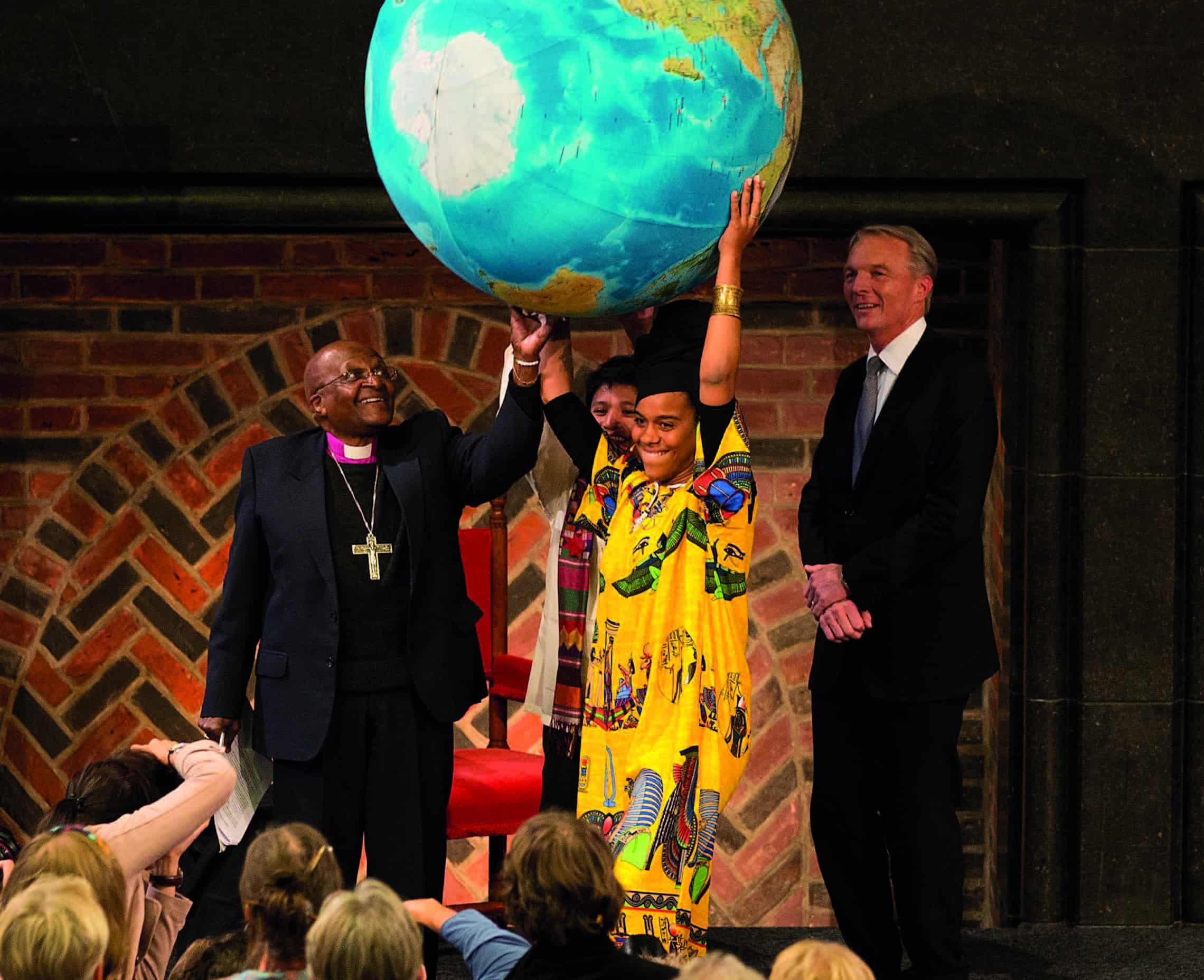
“Hey you oldies, listen to the children and act,” said Desmond Tutu during the International Children’s Peace Prize ceremony in the Knights’ Hall. He became the patron of the International Children’s Peace Prize in 2008.
I still remember our first meeting in 2002 in his modest office in Johannesburg. When I told him about my plans to establish KidsRights, he listened attentively and said in his beautiful African voice: “Aaah, you want to give a voice to the voiceless.”
Even after all these years, it remains my firm belief that children can move the world, just as the beautiful Children’s Peace Prize image shows.
Meanwhile, the Children’s Peace Prize statue, “The Nkosi”, named after the first Children’s Peace Prize winner Nkosi Johnson, has become a powerful icon recognised by children and adults across cultures. It depicts a child literally moving the world. The image was created by my wife, Inge Ikink.
Autumn 2014
Meanwhile, it is autumn 2014. I hear on the radio that Malala has won the Nobel Peace Prize, alongside Kailash Satyarthi. My eyes fill with tears and I immediately reach for the phone to congratulate them. How fantastic.
Together with Kailash, KidsRights has literally helped free thousands of children from child slavery since 2005. We carried out our last rescue operation in May 2014. I can still picture the stunned children emerging from the cramped workshops, unable to believe they were finally free.
Shortly before the radio announcement, we had been sitting around the table at Malala’s home, talking about everything that had happened since her nomination and about educational opportunities for girls, which we are now helping to create through the Children’s Peace Prize Project Fund in Pakistan.
Marc Dullaert
Chairman and Founder, KidsRights Foundation.